Look at that…whatever it is.

I had an unsettling moment today when it occurred to me that, perhaps, people don’t learn anything from museums.

I hope this is not true. I say this after having visited the marvellous Smithsonian Museum of Natural History, spending about 5 hours today perusing the galleries and shamelessly eavesdropping on people’s reactions to the exhibits. Kids were certainly excited about the exhibits and eagerly pointed things out to their parents. But what sorts of things did I overhear parents saying to their children? Continue reading

Congratulations Phil Bell!

Some congratulations are in order for my fellow grad student Phil Bell, who successfully defended his PhD thesis today!

Phil’s thesis is titled “Systematics and palaeobiology of the crested hadrosaurine Saurolophus, from Canada and Mongolia.” He’s been working for the Philip J. Currie Dinosaur Museum (previously the River of Death and Discovery Dinosaur Museum) since last fall.

You can read more about his work on Saurolophus in these papers; I’m sure there will be several more to come:

Bell PR, Evans DC. 2010. Revision of the status of Saurolophus (Hadrosauridae) from California, USA. Canadian Journal of Earth Sciences 47:1417-1426.

Bell PR. 2011. Redescription of the skull of Saurolophus osborni Brown 1912 (Ornithischia: Hadrosauridae). Cretaceous Research 32:30-44.

Bell PR. In press. Cranial osteology and ontogeny of Saurolophus angustirostris from the Late Cretaceous of Mongolia with comments on Saurolophus osborni from Canada. Acta Palaeontologica Polonica.

"Best" and "Worst" Dinosaur Names

A couple of articles I’ve come across recently have gotten me thinking about dinosaur names, in particular a pair of (admittedly fluffy) articles on about.com, the “10 Worst Dinosaur Names” and the “10 Best Dinosaur Names“.

It is interesting but somewhat disheartening to see how the public (and even other scientists, to be honest) react to certain dinosaur names, identifying them as ‘good’ or ‘bad’. What makes a dinosaur name good or bad? Continue reading

The winter term draws to a close, the fossils come out of hiding one last time.

We are very fortunate at the University of Alberta to offer several courses in Palaeontology (and not just through zoology or biology – they get their own PALEO course code). PALEO 418 and 419 cover vertebrate palaeontology in lecture and lab format, PALEO 414 focuses more on invertebrate paleontology and functional morphology, and PALEO 400 is a field school held right in Edmonton at the Danek hadrosaur bonebed. Continue reading

River of Death gets a name change.

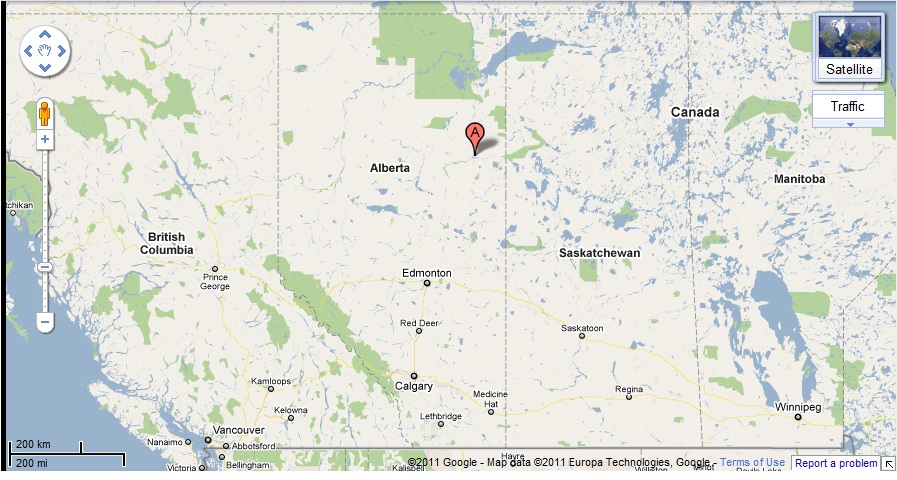
I haven’t talked a whole lot here about the Pipestone Creek Dinosaur Initiative or the proposed River of Death and Discovery Museum. The area around Grande Prairie, Alberta, about a five hour drive northwest of Edmonton, is rich in Late Cretaceous fossils. The most famous locality is Pipestone Creek, where hundreds of the horned dinosaur Pachyrhinosaurus perished millions of years ago.

For nearly ten years, a dedicated group of folks in Grande Prairie have been trying to get their own palaeontology museum off the ground. The working name for the museum was the River of Death and Discovery Dinosaur Museum. However, the word ‘death’ in the museum name has made it difficult for the museum to get as many sponsors as they would have liked.

And so it was announced yesterday that the museum would be renamed to the Philip J. Currie Dinosaur Museum! You can read more about the name change at the Grande Prairie Daily Herald-Tribune’s article.

There are some exciting things coming up this summer for the museum foundation, including the Akroyd Family and Friends Dinosaur Ball (yes, those Akroyds!), and the University of Alberta will return to our annual excavations at the Wapiti River Pachyrhinosaurus bonebed and the newly-reopened Pipestone Creek bonebed.

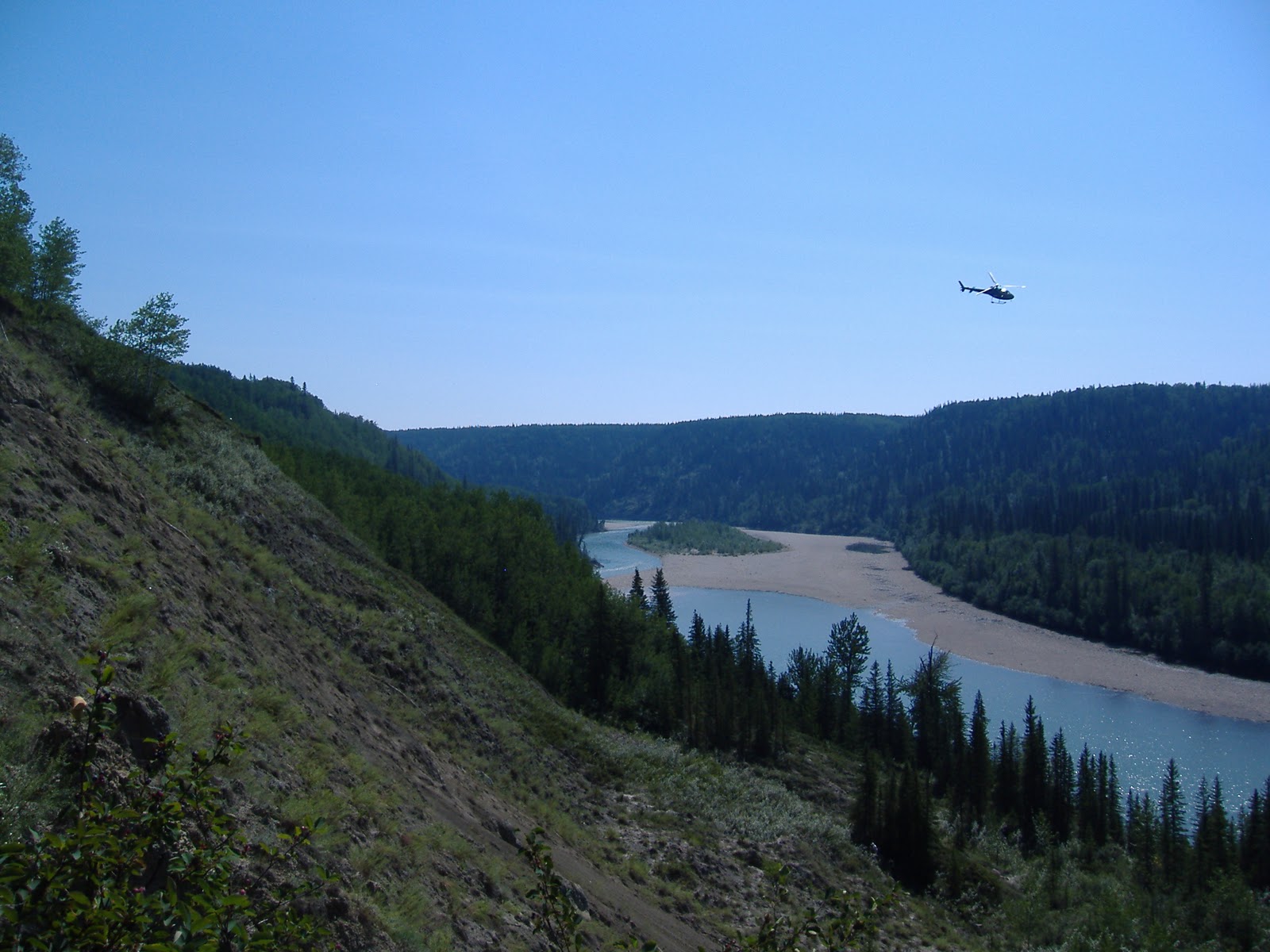
A helicopter approaches at the Wapiti River bonebed during the 2009 excavation. Helicopter lifts are the only way the large blocks can be brought up to the edge of the river valley.

Fossils in the Tar Sands.

A short but exciting post today!

“More fossils than fuel: dinosaur bones discovered.”

Shawn Funk, a shovel operator at Suncor Energy Mine near Fort McMurray, Alberta, found the remains of a possible ankylosaur earlier this week. The Royal Tyrrell Museum has been up to investigate and has posted some tantalizing photos on their Facebook page.Fort McMurray, for non-Canadians, is where all of the oil comes from.

This would not be the first vertebrate fossil discovered in the oil sands. The ichthyosaur Athabascasaurus bitumineus was named in 2010 by Patrick Druckenmiller and Erin Maxwell, and was found in a Syncrude Mine near Fort McMurray. The specimen was featured in the Royal Tyrrell Museum’s 25th Anniversary exhibition Alberta Unearthed – it is still oozing tar. It’s a beautiful specimen.

The well-known dinosaur-bearing formations of Alberta, like the Horseshoe Canyon Formation, Wapiti Formation, and of course the Dinosaur Park Formation, are all Late Cretaceous deposits. This new dinosaur, however, is from the Early Cretaceous, and is therefore likely to be quite different from the ankylosaurs known from southern Alberta. Ankylosaurs from this time period include lots of nodosaurs, like Sauropelta from Wyoming and Utah, Pawpawsaurus and Texasetes from Texas, and Cedarpelta (which may actually be a shamosaurine ankylosaurid – see Carpenter et al. 2008) from Utah. I will certainly be very interested to hear more about this new find! And great job to the folks at Suncor who spotted the fossil and called in the Tyrrell so quickly.

Papers!

Druckenmiller PS, Maxwell EE. 2010. A new Lower Cretaceous (lower Albian) ichthyosaur genus from the Clearwater Formation, Alberta, Canada. Canadian Journal of Earth Sciences 47: 1037–1053.

Carpenter K, Bartlett J, Bird J, Barrick R. 2008. Ankylosaurs from the Price River Quarries, Cedar Mountain Formation (Lower Cretaceous), east-central Utah. Journal of Vertebrate Paleontology 28: 1089–1101.

I like ankylosaur butts, and I cannot lie.

Yes, I seem to have this recurring fascination for the derrière of these dinosaurs. In 2009 I published a paper (with my fellow grad students Mike Burns and Robin Sissons) on Dyoplosaurus, in which we argued that the pelvis (specifically, the sacral ribs) is different than that of Euoplocephalus. I reconstructed the muscles of the tail and pelvis in my 2009 PLoS ONE paper on tail clubbing. Twice now I have spent significant portions of my summer preparing the pelvis of two different ankylosaur specimens. And now this month I have another paper (again with Mike Burns and my supervisor Phil Currie) on the ankylosaur pelvis, this time on the armour of the pelvic region.
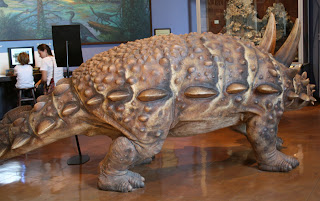
The lovely behind of Aletopelta, from my visit to the San Diego Natural History Museum in 2009. It is an excellent museum, you should check it out!

It has been recognized for a long time now that some ankylosaurs were doing really weird things with the armour over their pelvis. In some taxa, the osteoderms fuse together to form a carapace-like shield over the hips. Previously, the presence or absence of this shield has been used in phylogenetic analyses to examine whether or not a third group of ankylosaurs, the Polacanthidae, is a valid taxon (in addition to the Nodosauridae and Ankylosauridae). However, it is not just the presence or absence of the pelvic shield, but the way that the pelvic shield is constructed, that may be important.

In this paper I and my coauthors propose a revised way of looking at the pelvic shield that breaks shields up into three categories: 1. fused, rosette pattern, 2. fused, uniform-sized polygons, and 3. not fused. “But Victoria, if the osteoderms aren’t fused, then why call it a pelvic shield?” you may ask. Well, after looking at the AMNH’s Sauropelta and the BMNH’s Euoplocephalus, I noticed that although the osteoderms of the pelvis weren’t coossified, there also weren’t any transverse bands segmenting the body in that region (see image below of BMNH R5161, the holotype of Scolosaurus discussed in this post). Although the osteoderms aren’t fused together, they still form a continuous shield over the pelvis.
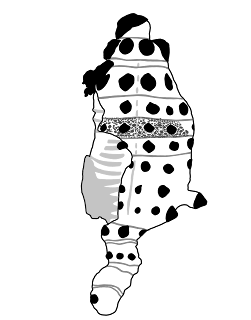
The always exciting headless, clubless, BMNH R5161, modified from Nopsca’s 1928 paper and as seen in Arbour et al. 2011.

More interesting, though, is what happens when we look at the other two categories – rosettes vs. uniform polygons – in a stratigraphic and geographic context. Rosettes are restricted to the Jurassic and Lower Cretaceous, whereas uniform polygons are primarily Upper Cretaceous. Uniform polygon shields are only found in North America (with the possible exception of Antarctopelta…which is from Antarctica). We did not run a phylogenetic analysis for this paper, but I plan to incorporate this data into subsequent analyses stemming from my PhD thesis on the phylogenetic relationships and biogeography of the Ankylosauridae. I will be very interested to see if any clades show up that reflect these stratigraphic and geographic patterns.

Here’s the paper! (behind a paywall, unfortunately…):

Arbour VM, Burns ME, Currie PJ. 2011. A review of pelvic shield morphology in ankylosaurs (Dinosauria: Ornithischia). Journal of Paleontology 85:298-302.

More papers about ankylosaur pelves!

Arbour VM, Burns ME, Sissons RL. 2009. A redescription of the ankylosaurid dinosaur Dyoplosaurus acutosquameus Parks, 1924 (Ornithischia: Ankylosauria) and a revision of the genus. Journal of Vertebrate Paleontology 29:1117–1135.

Arbour VM. 2009. Estimating impact forces of tail club strikes by ankylosaurid dinosaurs. PLoS ONE 4: e6738.

Ankylosaurus through the Ages

I saw a post up at Love in the Time of Chasmosaurs today – did you know Ankylosaurus could fly? The original Sinclair World’s Fair Ankylosaurus was being lifted by crane from the Houston Museum of Natural History as the museum undergoes expansion and renovations.

This got me thinking about a talk I gave for the Alberta Palaeontological Society annual meeting last March: “My ankylosaur is a big dumb tank! Ankylosaur reconstructions in the scientific literature and popular media.” I talked about why ankylosaurs are reconstructed in certain ways, both accurate and inaccurate. Darren Naish at Tetrapod Zoology has been talking about memes in palaeontological illustration, and how certain wacky reconstructions and poses pop up again and again. I think this is perhaps especially well illustrated by several ankylosaur taxa and today I’d like to talk about Ankylosaurus.

Brown 1908. The Ankylosauridae, a new family of armored dinosaurs from the upper Cretaceous. AMNH Bulletin 24:187-201. Continue reading