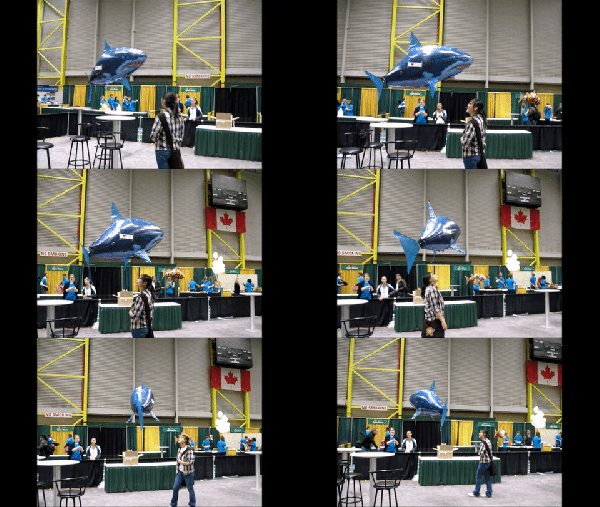
A shark flew! Continue reading
A shark flew! Continue reading
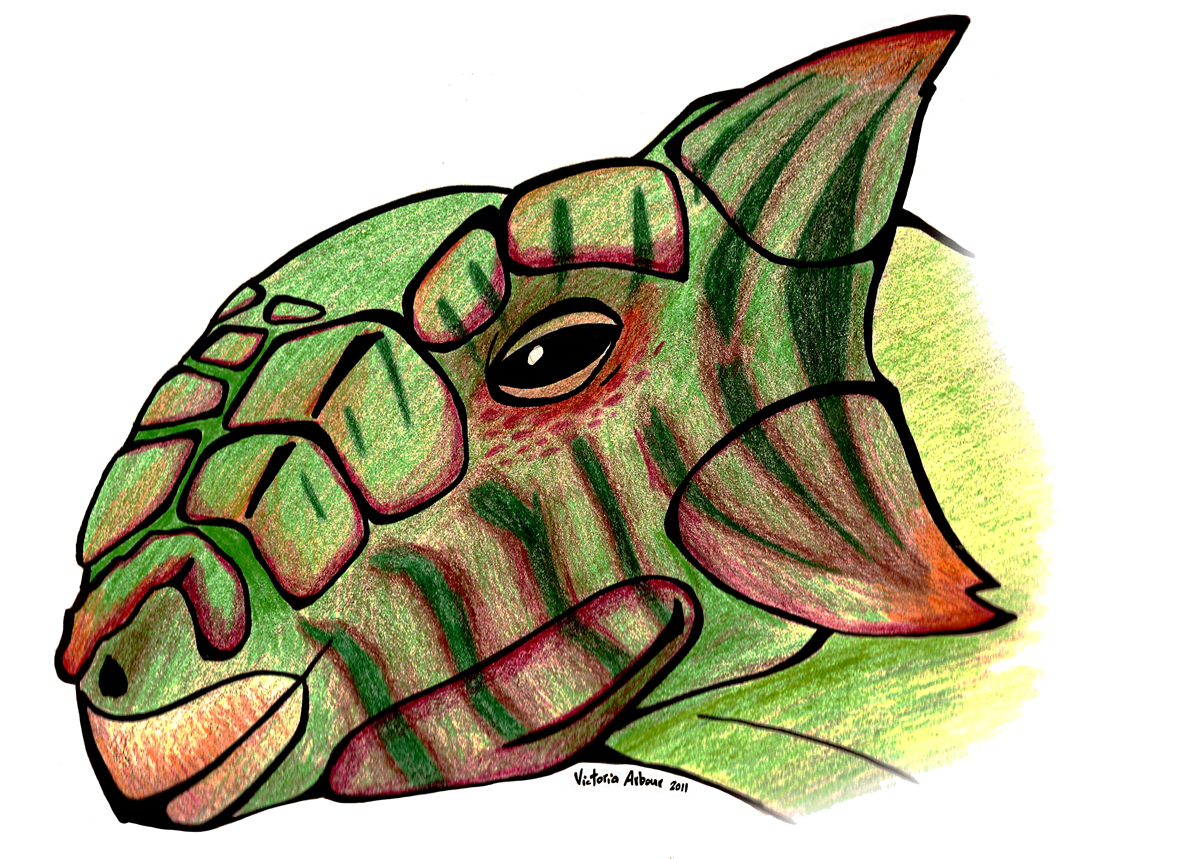
Say hello to Euoplocephalus, the best known ankylosaur you’ve never heard of. Besides Pinacosaurus from Mongolia and China, there are more specimens referred to Euoplocephalus than to any other ankylosaurid, and it is certainly the most well represented ankylosaurid from North America. Yet Euoplocephalus often gets overlooked because its younger cousin is THAT ankylosaur, the one that starred at the World’s Fair and was in Jurassic Park III and Clash of the Dinosaurs and Dinosaur Revolution and gets all the cool toys and, you know, is the namesake of the group. You know, Ankylosaurus. Well, hopefully you’ll be hearing more from me about Euoplocephalus over the coming months. Today we’ll be picking its nose. Continue reading
Last fall I visited the newly-opened Jurassic Forest and enjoyed it very much. However, because winter arrives early in Edmonton, the leaves had already fallen and the dinosaurs were quite snowy! Today I spent some time showing off ankylosaur fossils and casts with visitors at the forest, and had a chance to see the dinosaur trails in their summer greener. Here’s a few new photos from the forest!
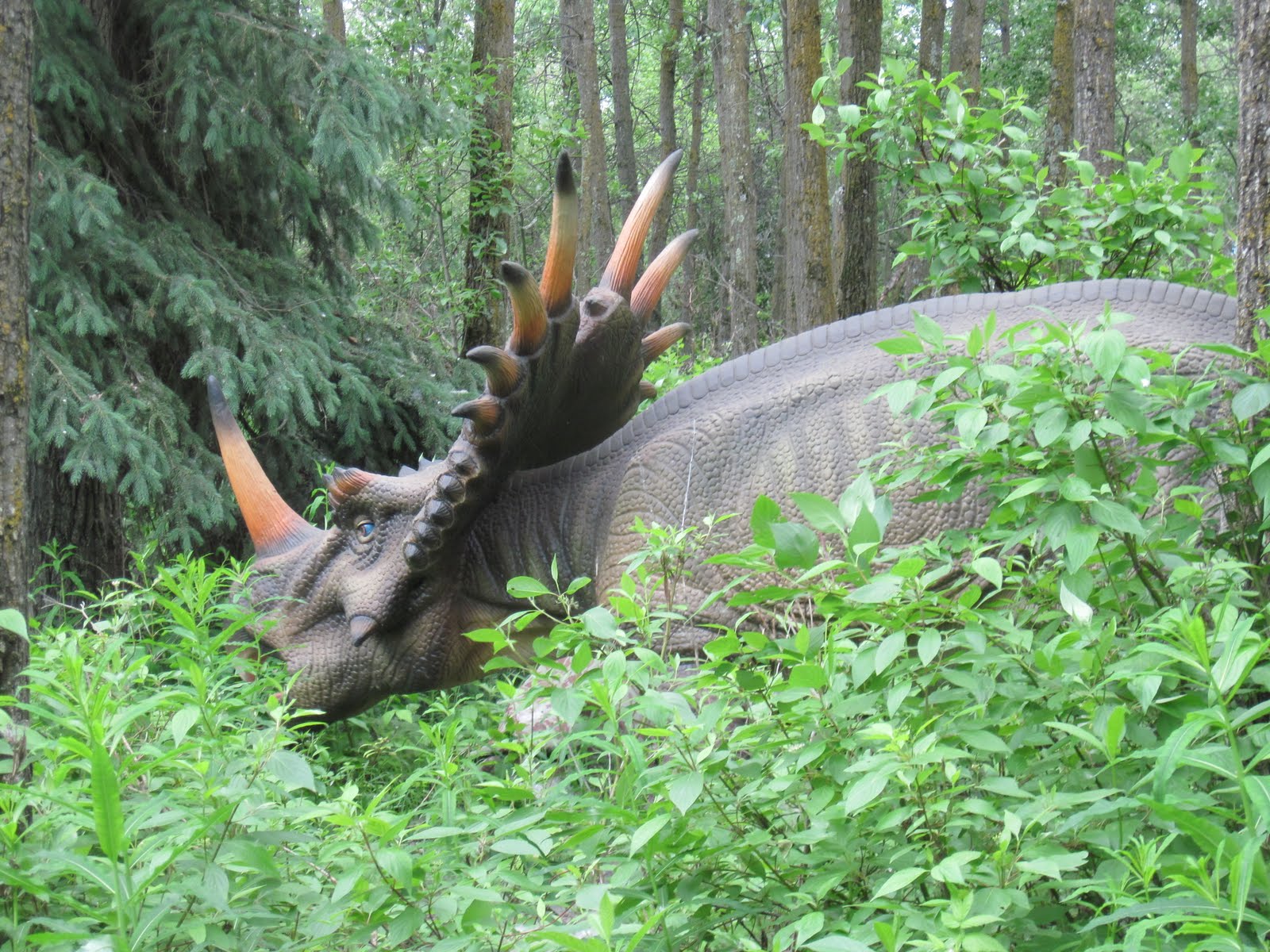 Styracosaurus looks like it’s in its natural environment. Continue reading
I’m back from a vacation to visit various family members scattered around the globe, including a stop in Toronto. It was time for a long overdue visit to the Ontario Science Centre, which I hadn’t visited since I was in my early teens, but which was one of my very favourite places when I was younger.
The Ontario Science Centre was built in 1969 and was a pretty revolutionary place at the time, as instead of the stereotypical ‘static’ museum displays pretty much everything was hands-on in some way. There are great exhibits on astronomy and the human body, an indoor rainforest with some really cool poison dart frogs, a fin whale skeleton, and the Science Arcade, which is probably one of the most fun science exhibits to play in. Continue reading
My most recent paper with my coauthor and supervisor Phil Currie appeared online at Historical Biology this week. It is the last of the chapters from my MSc on ankylosaur tail club biomechanics (although I am still working on ankylosaurs, the focus is now on the phylogenetic relationships within the ankylosaurids and their biogeography). However, it contains very little about the biomechanics of tail clubs…
Most of my MSc thesis used a lot of math and fancy-dancy computer modeling to look at whether it is biologically feasible for ankylosaurids to have used their tail clubs for forceful impacts (and therefore as offensive or defensive weapons). But another way to look for evidence of behaviour is to look for injuries, which can sometimes, if you’re lucky, give you clues about some of the more dramatic moments in an animal’s life. So as I was looking at specimens for my MSc (and into my PhD), I always kept an eye open for anything unusual or abnormal that could be a pathology. Continue reading
A short but exciting post today!
“More fossils than fuel: dinosaur bones discovered.”
Shawn Funk, a shovel operator at Suncor Energy Mine near Fort McMurray, Alberta, found the remains of a possible ankylosaur earlier this week. The Royal Tyrrell Museum has been up to investigate and has posted some tantalizing photos on their Facebook page.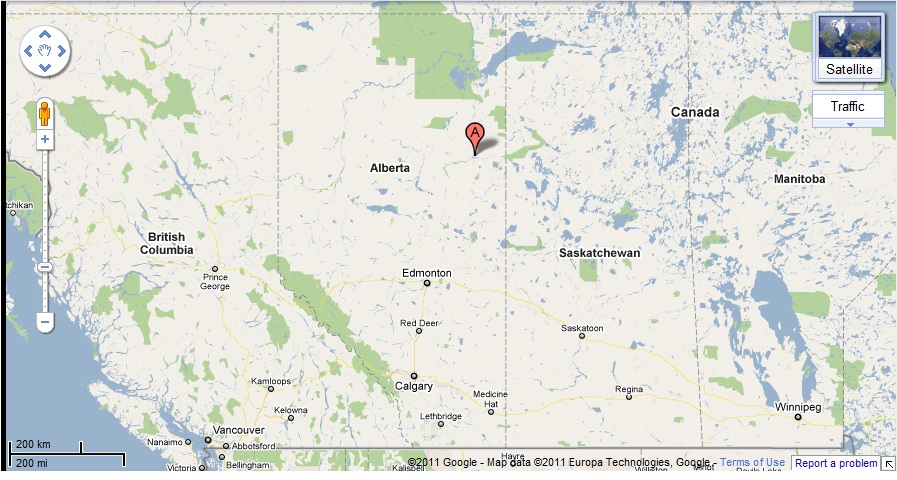 Fort McMurray, for non-Canadians, is where all of the oil comes from.
This would not be the first vertebrate fossil discovered in the oil sands. The ichthyosaur Athabascasaurus bitumineus was named in 2010 by Patrick Druckenmiller and Erin Maxwell, and was found in a Syncrude Mine near Fort McMurray. The specimen was featured in the Royal Tyrrell Museum’s 25th Anniversary exhibition Alberta Unearthed – it is still oozing tar. It’s a beautiful specimen.
The well-known dinosaur-bearing formations of Alberta, like the Horseshoe Canyon Formation, Wapiti Formation, and of course the Dinosaur Park Formation, are all Late Cretaceous deposits. This new dinosaur, however, is from the Early Cretaceous, and is therefore likely to be quite different from the ankylosaurs known from southern Alberta. Ankylosaurs from this time period include lots of nodosaurs, like Sauropelta from Wyoming and Utah, Pawpawsaurus and Texasetes from Texas, and Cedarpelta (which may actually be a shamosaurine ankylosaurid – see Carpenter et al. 2008) from Utah. I will certainly be very interested to hear more about this new find! And great job to the folks at Suncor who spotted the fossil and called in the Tyrrell so quickly.
Papers!
Druckenmiller PS, Maxwell EE. 2010. A new Lower Cretaceous (lower Albian) ichthyosaur genus from the Clearwater Formation, Alberta, Canada. Canadian Journal of Earth Sciences 47: 1037–1053.
Carpenter K, Bartlett J, Bird J, Barrick R. 2008. Ankylosaurs from the Price River Quarries, Cedar Mountain Formation (Lower Cretaceous), east-central Utah. Journal of Vertebrate Paleontology 28: 1089–1101.
Yes, I seem to have this recurring fascination for the derrière of these dinosaurs. In 2009 I published a paper (with my fellow grad students Mike Burns and Robin Sissons) on Dyoplosaurus, in which we argued that the pelvis (specifically, the sacral ribs) is different than that of Euoplocephalus. I reconstructed the muscles of the tail and pelvis in my 2009 PLoS ONE paper on tail clubbing. Twice now I have spent significant portions of my summer preparing the pelvis of two different ankylosaur specimens. And now this month I have another paper (again with Mike Burns and my supervisor Phil Currie) on the ankylosaur pelvis, this time on the armour of the pelvic region.

The lovely behind of Aletopelta, from my visit to the San Diego Natural History Museum in 2009. It is an excellent museum, you should check it out!
It has been recognized for a long time now that some ankylosaurs were doing really weird things with the armour over their pelvis. In some taxa, the osteoderms fuse together to form a carapace-like shield over the hips. Previously, the presence or absence of this shield has been used in phylogenetic analyses to examine whether or not a third group of ankylosaurs, the Polacanthidae, is a valid taxon (in addition to the Nodosauridae and Ankylosauridae). However, it is not just the presence or absence of the pelvic shield, but the way that the pelvic shield is constructed, that may be important.
In this paper I and my coauthors propose a revised way of looking at the pelvic shield that breaks shields up into three categories: 1. fused, rosette pattern, 2. fused, uniform-sized polygons, and 3. not fused. “But Victoria, if the osteoderms aren’t fused, then why call it a pelvic shield?” you may ask. Well, after looking at the AMNH’s Sauropelta and the BMNH’s Euoplocephalus, I noticed that although the osteoderms of the pelvis weren’t coossified, there also weren’t any transverse bands segmenting the body in that region (see image below of BMNH R5161, the holotype of Scolosaurus discussed in this post). Although the osteoderms aren’t fused together, they still form a continuous shield over the pelvis.

The always exciting headless, clubless, BMNH R5161, modified from Nopsca’s 1928 paper and as seen in Arbour et al. 2011.
More interesting, though, is what happens when we look at the other two categories – rosettes vs. uniform polygons – in a stratigraphic and geographic context. Rosettes are restricted to the Jurassic and Lower Cretaceous, whereas uniform polygons are primarily Upper Cretaceous. Uniform polygon shields are only found in North America (with the possible exception of Antarctopelta…which is from Antarctica). We did not run a phylogenetic analysis for this paper, but I plan to incorporate this data into subsequent analyses stemming from my PhD thesis on the phylogenetic relationships and biogeography of the Ankylosauridae. I will be very interested to see if any clades show up that reflect these stratigraphic and geographic patterns.
Here’s the paper! (behind a paywall, unfortunately…):
Arbour VM, Burns ME, Currie PJ. 2011. A review of pelvic shield morphology in ankylosaurs (Dinosauria: Ornithischia). Journal of Paleontology 85:298-302.
More papers about ankylosaur pelves!
Arbour VM, Burns ME, Sissons RL. 2009. A redescription of the ankylosaurid dinosaur Dyoplosaurus acutosquameus Parks, 1924 (Ornithischia: Ankylosauria) and a revision of the genus. Journal of Vertebrate Paleontology 29:1117–1135.
Arbour VM. 2009. Estimating impact forces of tail club strikes by ankylosaurid dinosaurs. PLoS ONE 4: e6738.
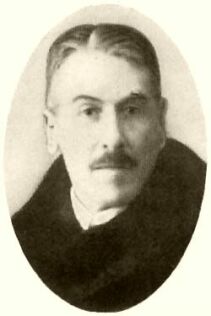

Baron von Nopcsa is a pretty cool dude, maybe even as cool as Freddie Mercury. Born in 1877 in Transylvania, he is probably best known for his work on the Haţeg fauna of Romania.
Nopcsa also published a lot of papers on ankylosaurs!
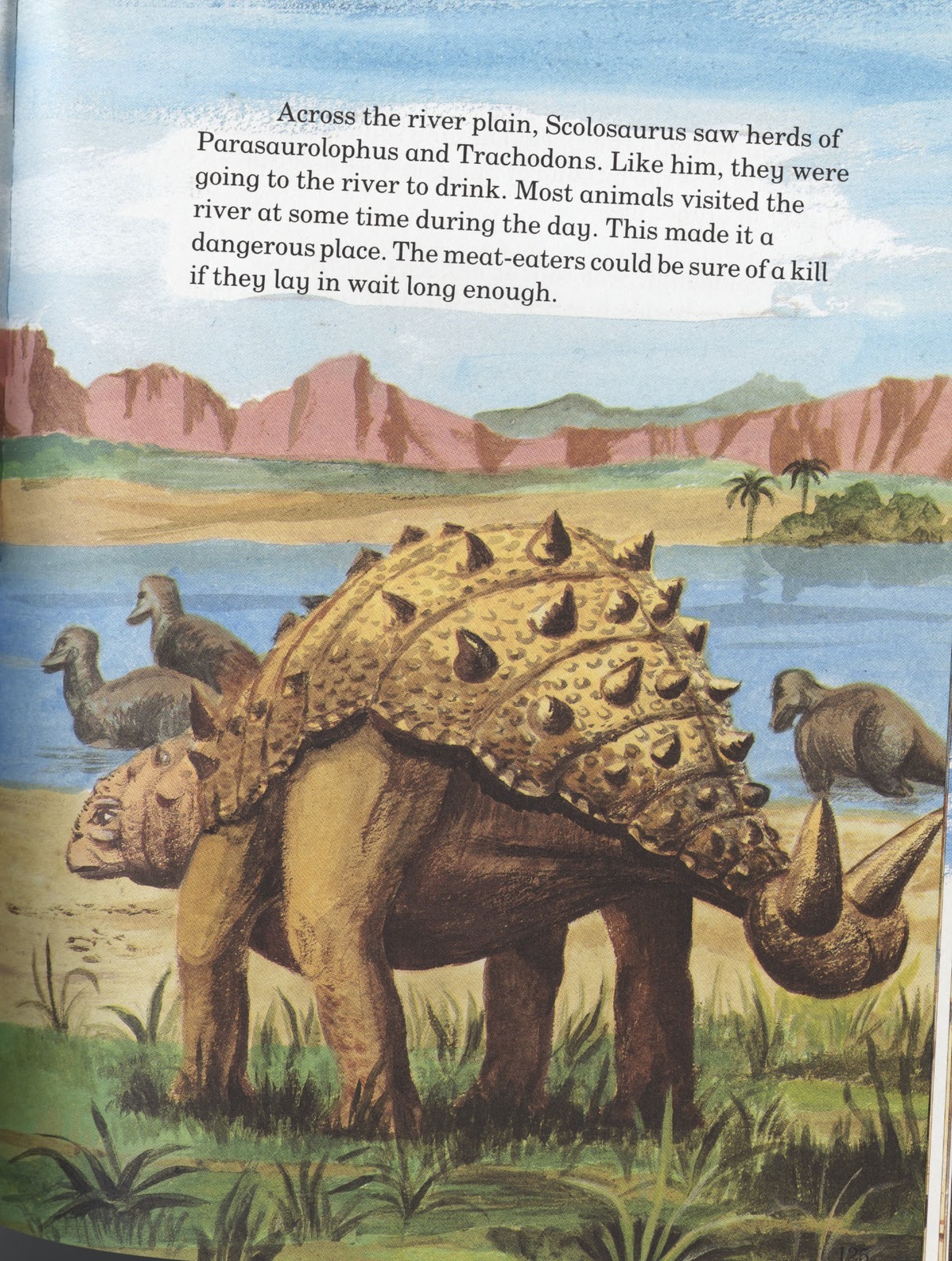
Like SCOLOSAURUS!
(This image is from an awesome book I found at WalMart – the Colossal Book of Dinosaurs) Continue reading
I saw a post up at Love in the Time of Chasmosaurs today – did you know Ankylosaurus could fly? The original Sinclair World’s Fair Ankylosaurus was being lifted by crane from the Houston Museum of Natural History as the museum undergoes expansion and renovations.
This got me thinking about a talk I gave for the Alberta Palaeontological Society annual meeting last March: “My ankylosaur is a big dumb tank! Ankylosaur reconstructions in the scientific literature and popular media.” I talked about why ankylosaurs are reconstructed in certain ways, both accurate and inaccurate. Darren Naish at Tetrapod Zoology has been talking about memes in palaeontological illustration, and how certain wacky reconstructions and poses pop up again and again. I think this is perhaps especially well illustrated by several ankylosaur taxa and today I’d like to talk about Ankylosaurus.

Brown 1908. The Ankylosauridae, a new family of armored dinosaurs from the upper Cretaceous. AMNH Bulletin 24:187-201. Continue reading
 pseudoplocephalus