Vesuvio!

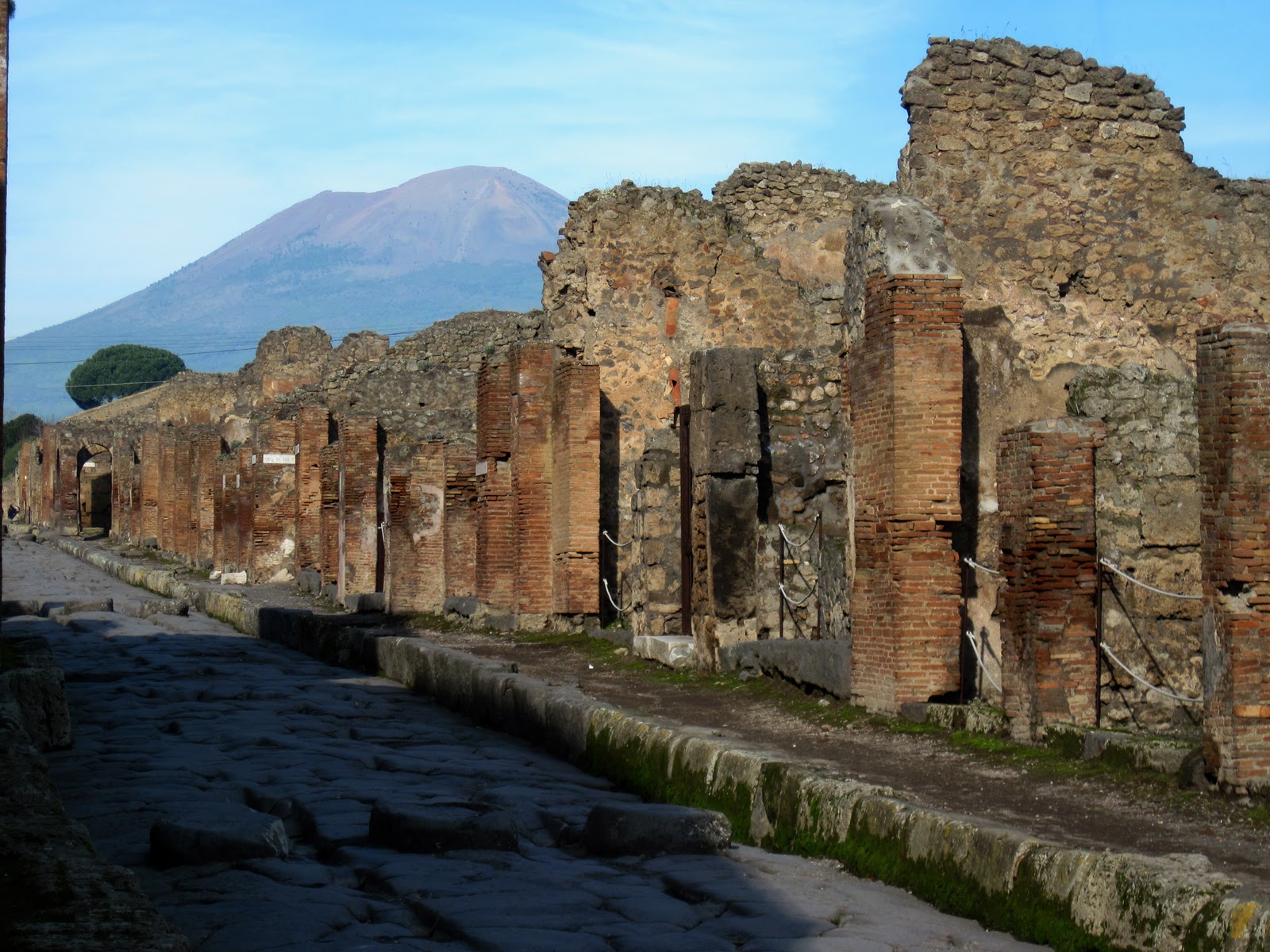
This Christmas break my family decided to trek down to Pompeii to visit the ruins and Mount Vesuvius, something that I have wanted to do for a long time. If you’ve ever taken an introductory geology class, then you’ve probably heard the story of the eruption of Vesuvius in 79 AD, as it is used to illustrate several concepts about volcanic eruptions. The 79 AD eruption began with a Plinian eruption, where a large column of ash extends high into the air, as far as the stratosphere. The term “Plinian eruption” is derived directly from the 79 AD Vesuvius eruption – Pliny the Younger was one of the first people to describe a volcanic eruption in detail. There are many examples of Plinian eruptions from the last few decades – Mount Pinatubo in 1991, Mount St. Helens in 1980, and most recently, Eyjafjallajökull in 2010. After a day of Plinian-style eruption, several pyroclastic flows covered the cities of Pompeii, and, in particular, Herculaneum. Like many other volcanos, Mount Vesuvius is found at the intersection of two plate boundaries. The African Plate is subducting (diving down) beneath the Eurasian Plate, and as this occurs, melted rock moves up towards the surface and eventually erupts from the volcano. Continue reading

Flying away again…

I arrived in Ulaanbaatar last Saturday and am heading out to the Gobi Desert tomorrow morning. I’ve got a few blog posts that will appear while I’m away, but emails and facebook will be on hiatus until I return in late September.

However, I will leave you with a few palaeo notes and photos before I disappear for four weeks. During the Flugsaurier Symposium Scott and I had the opportunity to go on a field trip to Liaoning province to visit Jehol group outcrops and museums. Yesterday I posted a few photos of the Chaoyang Geopark. Today I’ve got some pictures of the Sihetun Fossil Museum and Darwinopterus field locality.
Continue reading

Chaoyang Geopark


During the Flugsaurier Symposium I went on a field trip to Liaoning Province, which was a great opportunity to see different parts of China and visit Jehol group outcrops and museums. We first visited the Chaoyang Fossil Bird Geopark, which included a museum, in situ exhibits, parks, and lots of interesting statues. This is Nurhachius, an istiodactylid pterosaur from the Jiufotang Formation. The model has too many teeth, but he’s still pretty fun.


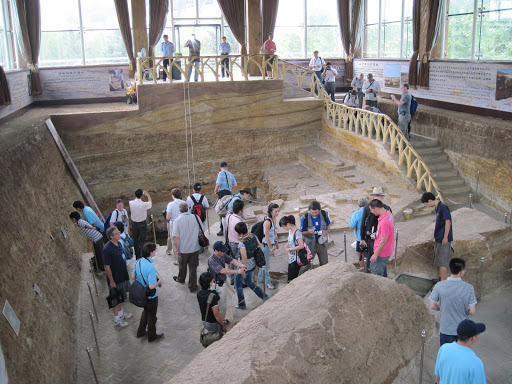
One of the best parts of the visit was this great in situ display exposing Jehol Group rocks. It had fairly good descriptions of the geology, and even marked on faults and other interesting features. Fossils discovered during the excavation were left in place, and included Cathayornis, Shenzhouraptor, and lots of fish.


Inside the museum proper were literally hundreds of Liaoning fossils of every sort – insects, plants, fish, turtles, champsosaurs, theropods, birds, pterosaurs – the list goes on and on. Here’s just a single display case showing off various fossil birds – I think they are all Confuciusornis, but may be mistaken.
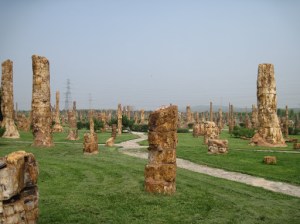

It was easy to be overwhelmed by the sheer volume of fossil material in the geopark. After we finished in the museum we entered the fossil forest full of enormous petrified stumps. Incredible!

The museum and geopark had a few glitches – some specimens were mislabelled or in the wrong hallway, and there may have been a few ‘plussed’ specimens on display – but it was a really cool place that certainly has a lot of potential if a few of these errors are fixed up. Continue reading